Every agency owner hits the same wall eventually. Leads keep coming in, but SEO delivery bandwidth does not stretch to match them, and hiring a full in-house team is neither fast nor cheap. This is precisely the gap white label SEO was built to close. Instead of adding headcount for every new retainer, an agency quietly hands off execution to a specialized partner and delivers the results under its own name. In 2026, with the SEO services market now valued near
$84 billion and growing at roughly 12% a year, white label SEO has stopped being a stopgap. For agencies scaling their own service lines, it has become the standard operating model for growing client capacity without growing payroll at the same rate.
What Is White Label SEO, and Why Is Every Agency Talking About It in 2026?
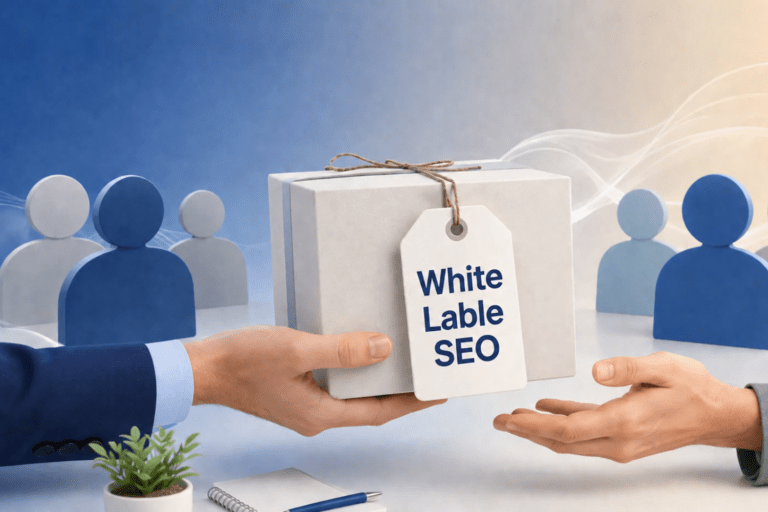
White label SEO is simple in concept: a third-party provider handles the technical audits, content production, link building, and reporting, while your agency owns the client relationship, the branding, and the strategy conversation. The client never sees the provider’s name. They see your logo on the dashboard and your account manager on the call.
What changed in 2026 is scale and sophistication. Providers now routinely fold AI Overview tracking, structured data, and generative search visibility into standard packages instead of treating them as an upsell. Boostability alone supports more than 30,000 active client accounts through its reseller network, and DashClicks now serves over 20,000 partner agencies through its white label platform. Those numbers only make sense if the underlying delivery model actually works at volume, and it does. That volume is also exactly why quality control matters more than ever when you pick a partner, something worth coming back to below.
The Real Math Behind Doubling Client Capacity
Here is the arithmetic most agency owners skip. A senior technical SEO specialist in the US now commands somewhere between $75,000 and $95,000 a year. Add a content writer, a link building specialist, and a tools stack and a fully staffed in-house SEO department can run past $300,000 annually before it produces a single deliverable. That is the cost of serving maybe 15 to 25 client accounts, depending on scope.
Route the same work through a white label SEO partner and the cost structure flips from fixed to variable. Agencies typically resell at two to three times the wholesale rate and retain gross margins in the 45 to 65% range. Instead of one senior hire covering a finite number of accounts, account managers can onboard new clients continuously, because fulfillment capacity scales with the partner, not with the next hiring cycle. That is the actual mechanism behind doubling capacity. It is not a slogan; it is what happens once delivery stops being the bottleneck and sales becomes the only real constraint left.
Is White Label SEO Worth It in 2026?
For most small to mid-size agencies, yes, and the reasoning is not complicated. Building SEO expertise in-house from scratch takes 12 to 18 months before results even show up for clients, and that is after hiring correctly the first time. A white label SEO partner brings a working system on day one: proven processes, existing tooling, and a bench of specialists who have already solved most of the edge cases a first in-house hire would still be learning. The tradeoff is real too. Some direct control is given up, and agency reputation now depends partly on someone else’s execution. That is exactly why partner selection deserves more diligence than most agencies give it.
What Does White Label SEO Actually Cost?
Pricing in 2026 tends to fall into three bands. Local, single-location scopes run roughly $300 to $900 a month wholesale. Mid-market campaigns with content and link building sit between $900 and $2,500. Ecommerce and enterprise scopes, with more technical complexity and competitive keyword sets, run $2,500 to $6,000 or more. Agencies then mark those numbers up for retail pricing, which is how tiered structures such as Silver, Gold, and Platinum packages tend to emerge naturally as scope and competitiveness increase.
One honest warning: if a provider quotes a full retainer under $300 a month, ask which corner is being cut, because one always is. Usually it is templated audits, AI-generated content with no editorial review, or link sourcing from low-quality marketplaces, and all three become the agency’s problem the moment a client notices.
Built for the New Search Reality: AEO, GEO, and AI Overviews
This is the part that has genuinely changed the game since 2024. Google’s AI Overviews now appear on somewhere between 48% and 60% of US searches as of early 2026, and organic click-through rates drop by more than half when one shows up on a query. Meanwhile ChatGPT Search, Perplexity, and Gemini have created an entirely new discovery layer that keyword-only SEO was never designed to handle.
That is why Answer Engine Optimization (AEO) and Generative Engine Optimization (GEO) are no longer optional add-ons; they are baseline expectations for any credible SEO reseller in 2026. A capable white label SEO partner structures content for extractive answers, meaning clear definitions, direct answer blocks, and tight structured data, so client sites can earn citations inside AI Overviews and chatbot responses rather than only ranking somewhere underneath them. It is a sobering reminder for anyone who assumes brand size alone protects traffic. Even HubSpot, one of the most recognized names in inbound marketing, has publicly experienced a notable drop in organic search visitors as AI Overviews and zero-click search reshape how people find information. If a company with HubSpot’s content depth and domain authority is not immune, smaller client sites certainly are not either, and that is exactly the risk a strong AEO and GEO layer is meant to manage.
Can White Label SEO Help You Show Up in ChatGPT and AI Overviews?
Yes, when the provider is actually built for it. That means structured data implementation, author and entity schema, FAQ blocks that mirror real People Also Ask queries, and content refreshed frequently enough to stay eligible for citation, since pages updated within the last 60 days are meaningfully more likely to be pulled into AI answers. Ask any potential white label SEO partner directly how they track AI Overview and ChatGPT citations, not just keyword rankings. If they cannot answer specifically, they are still fighting the last decade’s search war.
How to Choose a White Label SEO Partner Without Getting Burned
A few non-negotiables, based on what actually separates strong partnerships from weak ones:
- Ask for case studies with before-and-after ranking and traffic data, not vague testimonials.
- Confirm reports and deliverables ship fully under your branding, down to the spreadsheet templates.
- Get clarity on AI-era capabilities: structured data, AEO, GEO, and AI Overview tracking, not just link volume.
- Set a weekly or biweekly sync cadence so nothing slips silently, especially in the first 60 days of a handoff.
- Start with one or two accounts before handing over the whole roster. Fulfillment quality is easier to judge in a small sample.
My Take
Having watched this shift play out across real estate, finance, healthcare, and ecommerce clients, my honest opinion is that agencies who resist white label SEO purely out of a “we do everything in-house” mindset are choosing pride over growth. Clients do not care who is on the other end of the keyboard. They care whether their organic traffic and leads are climbing every quarter. The agencies that will win the next few years are the ones treating white label SEO as an extension of their own team, held to the same quality bar, rather than as a cheap shortcut to bigger margins.
That said, white label SEO is not a fix for a broken sales process, and it will not save an agency that picks a partner on price alone. Vet carefully, start small, and let the relationship earn more of your roster as trust builds.
Where Pixel Dot Media Fits In
Scaling client capacity without sacrificing quality is a problem we think about constantly at Pixel Dot Media, both for our own SEO services and for the brands and agencies we support across real estate, finance, healthcare, fashion, and ecommerce. If you are exploring whether a white label or partner-driven SEO model fits your agency, our portfolio of client results is a reasonable place to start, or you can simply get in touch and compare notes on what is actually working in 2026.
FAQ Section
What is white label SEO?
White label SEO is a service model where a specialized provider performs SEO work (technical audits, content, link building, reporting) on behalf of an agency, which then delivers that work to its own clients under its own brand name.
How much does white label SEO cost in 2026?
Wholesale pricing generally runs $300 to $900 a month for local scopes, $900 to $2,500 for mid-market campaigns, and $2,500 to $6,000 or more for ecommerce and enterprise work, with agencies typically reselling at a 45 to 65% gross margin.
Is white label SEO worth it for small agencies?
For most small and mid-size agencies, yes. It removes the 12 to 18 month ramp-up of building an in-house team and lets an agency start delivering credible SEO results immediately, as long as the partner is vetted carefully.
Can white label SEO improve visibility in AI Overviews and ChatGPT?
Yes, provided the partner actively works on Answer Engine Optimization and Generative Engine Optimization, including structured data, schema markup, and frequently refreshed content designed for extractive, citation-friendly answers.
How do I choose the right white label SEO partner?
Look for verifiable case studies, fully branded reporting, clear AI-era capabilities, a consistent communication cadence, and start with a small test engagement before transferring your full client roster.